
 |
 |
|
|
Have a Question ?
If you have questions regarding spiritual life, Vedanta, Hinduism etc, you can email us at answers ATvedantaprov.org
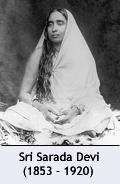
Sri Sarada Devi
|
Strange and fascinating is the story of the marriage of Sri Ramakrishna and Sri Sarada Devi - the Holy Mother. Ramakrishna's relations in Kamarpukur thought that he had turned mad as a result of the over-taxing spiritual exercises he had been going through at Dakshineswar. Alarmed, they thought that if he gets married, he would be more conscious of his responsibilities to the family. Although he had no desire for pleasures of the married life he,did not oppsed to this idea; he in fact mentioned Jayrambati, three miles to the north-west of Kamarpukur, as being the village where the bride could be found at the house of one Ramchandra Mukherjee. The bride, five-years old and bearing the name, Sarada, was found. The marriage was duly solemnized. The bride went back to her father's house and Ramakrishna went back to Dakshineswar to resume his spiritual practices.
Years passed and the bride and the bridegroom seldom met. Sarada continued to live at her father's house, helping her peasant parents with the usual chores of feeding the cattle, carrying food to the paddy-fields for laborers, cooking, cleaning, looking after the younger brothers, and so on. As she grew older, neighbors began to gossip about her misfortune. They would say that her husband had gone mad. Sarada overheard such remarks and was naturally disturbed. She decided to go to Dakshineswar and see for herself the condition of her husband. She went and found her husband quite normal and loving. She stayed with him for some time and then returned to Jayrambati. After some years, she permanently stayed with him.
In a way, Sarada Devi was Ramakrishna's first disciple. He taught her everything
he learnt from his various Gurus. Ramakrishna must have been pleased to see
that she mastered every religious secret as quickly as he himself has done,
perhaps even more quickly. Impressed by her great religious potential, he
began to treat her as the Universal Mother Herself. He said, 'I look upon
you as my own mother and the Mother who is in the temple'.
Ramakrishna fell sick with cancer in the throat. He was removed to Cossipore
for treatment. By now he had come to be known as a great religious teacher.
Many of the Calcutta elite came under his influence, but Ramakrishna was not
satisfied until he had a band of young men who were prepared to mould themselves
strictly according to his instructions. Such young men, fifteen or sixteen
in number came, all with a good family backgrounds and modern education. It
is this band of young men who later formed the Ramakrishna Order. Before passing
away, in 1886, Ramakrishna made Sarada Devi unfold her Divine Motherhood;
she became mother of these young men, nay of the entire humanity. At first,
Sarada Devi was shy about playing this role, but slowly, she filled that role,
and even became a religious teacher in her own rights.
For the thirty-four years or so that she lived after Ramakrishna's passing
away, she inspired people, both monastic and lay, with the ideals that Ramakrishna
himself had preached and practiced. She did this in the same way as Ramakrishna.She
lived those ideals. But her life was more testing and complicated than Ramakrishna's.
Being an ideal monk, Ramakrishna always kept away from the cross-currents
of a family life. He loved to watch the fun called life but was careful enough
never to be drawn into its maelstroms. Sarada Devi, on the contrary, was at
the very heart of it. She was the head of a large family comprising men and
women, most of them not even distantly related to her.
Sarada Devi had a hard life from the beginning to end. As a daughter, wife,
and finally, as the beloved Mother of a large community of people cutting
across race and language, there were many demands placed on her, many more
than a woman in her circumstances usually had to meet. She fulfilled them
in a manner possible only for her. But what is remarkable is that, in the
midst of all her cares, she maintained a degree of aloofness which Hinduism
attributes to the highest and best among men and women. Through the skein
of all the varying situations which she faced, she remained absolutely calm
as if these were no concern of hers. But the most amazing thing about her
was her renunciation, a quality she shared with her husband in a measure equal
to, if not more than, his.
She taught not by percepts but by examples. There were many irritants in the
way people around her behaved, but she was an indulgent mother who knew the
best way to educate an erring child was to set an example before them, which
she did. She had seen the worst side of people, but she never lost faith in
them, knowing that, given affection, sympathy, and guidance, they could overcome
all limitations.
She was human, yet divine. Her divinity shone through everything she did,
even if it was something entirely mundane. She was a simple woman, but in
thought, speech, and action she was attuned to God. She was a true saint,
but she never claimed she was. She passed as an ordinary woman, but everything
about her was extraordinary.
Teachings of Sri Sarada Devi:
|
Recommended Reading:
|